
The context: a fund, and a £500k question
Camden Council's Community Wealth Fund invests in local businesses that deliver social value. To shape how the fund deploys capital, the Council needed to test which investment vehicles would best support business growth in the borough.
The Council convened 59 people from Camden's local business ecosystem — owners, investors and others — for a structured PSi discussion. The question on the table:
What is the best type of investment that would enable your business to grow in the next 5 years?
Ten investment vehicles were tested, ranging from equity-backed investment to low-interest debt. Going in, the team had a working hypothesis: equity-backed investment between £0 and £500k would emerge as the preferred option.
The surprise: revenue-based financing came out on top
It didn't. After three rounds of deliberation, the clear winner was revenue-based financing under £500k — a structure where repayments scale with the business's profits rather than following a fixed schedule.
For a fund about to deploy real money, this was strategically significant. But it raised an uncomfortable question.
The pushback: was this group insight, or one persuasive voice?
One participant was a professional investor with deep knowledge of financing structures. They strongly favoured revenue-based financing and allocated all of their votes to that option. They were also a confident, persuasive contributor across the PSi discussions.
Camden's team flagged the risk immediately: was revenue-based financing genuinely the discussion's preference, or was the outcome being driven by one influential voice?
That is exactly the kind of question deliberative platforms have to answer — and exactly the kind of question PSi's analysis is built for.
Verifying the result
To answer Camden's question with confidence, PSi runs a series of complementary checks built into the platform. Each looks at the same finding from a different angle.
1. Were the arguments coming from many people, or just a few?
PSi's argument analysis works through every transcript and surfaces every distinct reason participants raised for and against each idea, grouping them into themes and tracking who said what.
For revenue-based financing it surfaced 99 distinct supporting themes and 46 critical ones. Participants repeatedly described the structure as flexible because repayments adapt to profit. But they also recognised the downside: it is still a debt-like obligation, and it can become expensive in good years. These were nuanced positions argued by many different speakers, not soundbites repeated from one source.
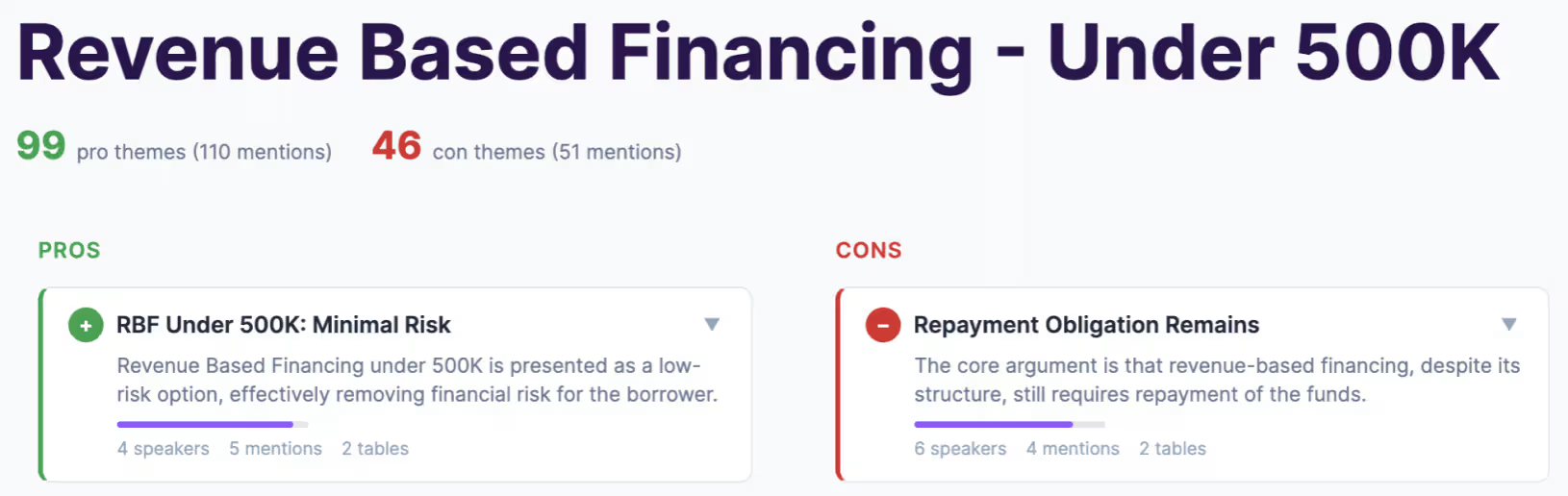
Figure 1: PSi argument analysis for revenue-based financing
The platform extracts every distinct reason participants raised for and against each investment vehicle and groups them into themes, with the number of speakers and tables that contributed to each.
What you are seeing: 99 supporting themes and 46 critical themes, each one independently argued for by multiple speakers across the discussion — not soundbites repeated from one source.
2. Did people consistently spend more of their votes on it?
PSi checks the number of votes each participant gave to each idea, then tests whether the averages differ significantly between ideas — accounting for how consistently different people voted.
On this measure, two ideas came clearly ahead of the rest: revenue-based financing and industry support. They were statistically tied with each other — participants consistently allocated similarly high numbers of votes to both, with no significant gap between them. Both, however, were significantly above equity investment in third place.
The lead at the top of the field came from broad and consistent backing across many participants — not from a small number of people happening to vote unusually heavily.
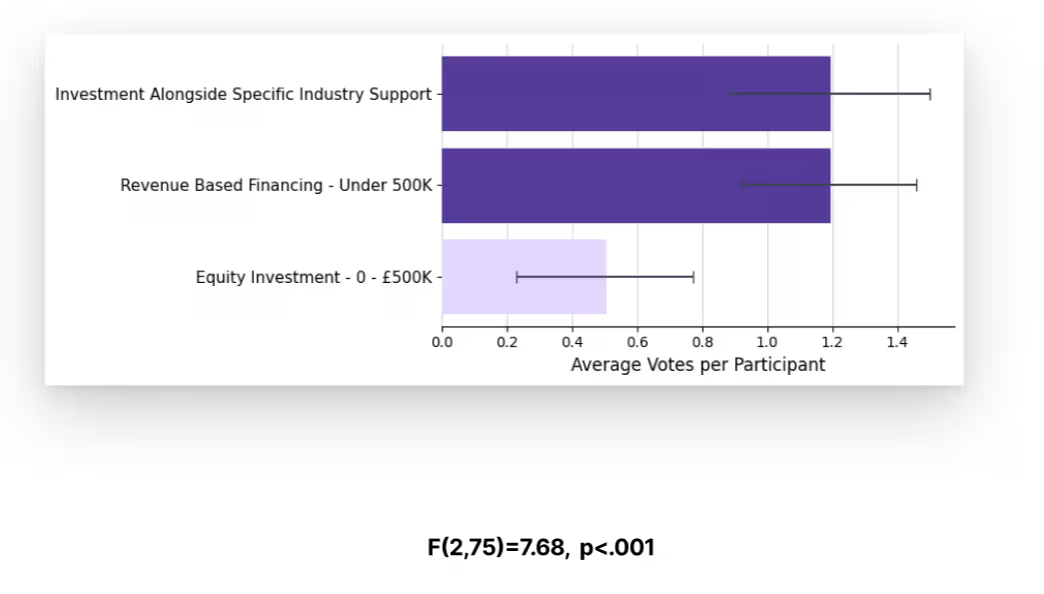
Figure 2: Average votes per voter for the top three ideas
The chart shows the average number of votes participants spent on each of the top three investment vehicles, with error bars indicating how consistently those votes were placed across people.
What you are seeing: revenue-based financing and industry support sit at the top with overlapping error bars — participants consistently gave them similarly high numbers of votes, and the gap between them is not statistically significant. Both are significantly above equity investment in third place. The lead at the top of the field comes from consistent support across many participants, not from a small number of heavy voters.
3. Was support broad across the whole discussion?
The next check asked a different question: what share of the discussion's total vote-weight went to revenue-based financing relative to the alternatives?
The answer was clear. Revenue-based financing attracted a meaningfully larger share than any rival, with statistical confidence above 99.8% against every alternative tested. And the lead was so robust that it held even when the investor's votes were removed from the dataset entirely.
4. Did the people who heard the investor argue end up voting like them?
The final check was the most direct test of the influence concern. If the investor's enthusiasm was driving the outcome, the people who heard them argue first-hand should look the most like them in the data.
With PSi you can easily compare the investor's voting pattern with each person they had spoken to directly during the discussion. The result was the opposite of what the worry predicted: their fellow participants did not converge on the investor's preference. Some shifted towards revenue-based financing after the conversation; others shifted away. One participant voted in the opposite direction.
Persuasion didn't propagate. People listened, weighed what they heard, and made their own decisions.
What this demonstrates
Four checks, all pointing the same way:
- Many people argued for it, with distinct reasoning, not echo-chamber agreement.
- Backing was consistent across many participants, not concentrated in a few heavy voters.
- The result survived removing the most influential participant entirely.
- The investor's discussion partners didn't follow their lead, so direct influence wasn't propagating either.
This is the kind of evidence that lets a public body act on a deliberation rather than just report on it.
The outcome
Today, if you visit the Camden Community Wealth Fund website, revenue-based financing under £500k is one of the investment products offered to local businesses. The analysis turned a structured community conversation into a real investment decision — backed by statistical evidence, not assumption.