
PSi Demo Game - The Analysis Workstation
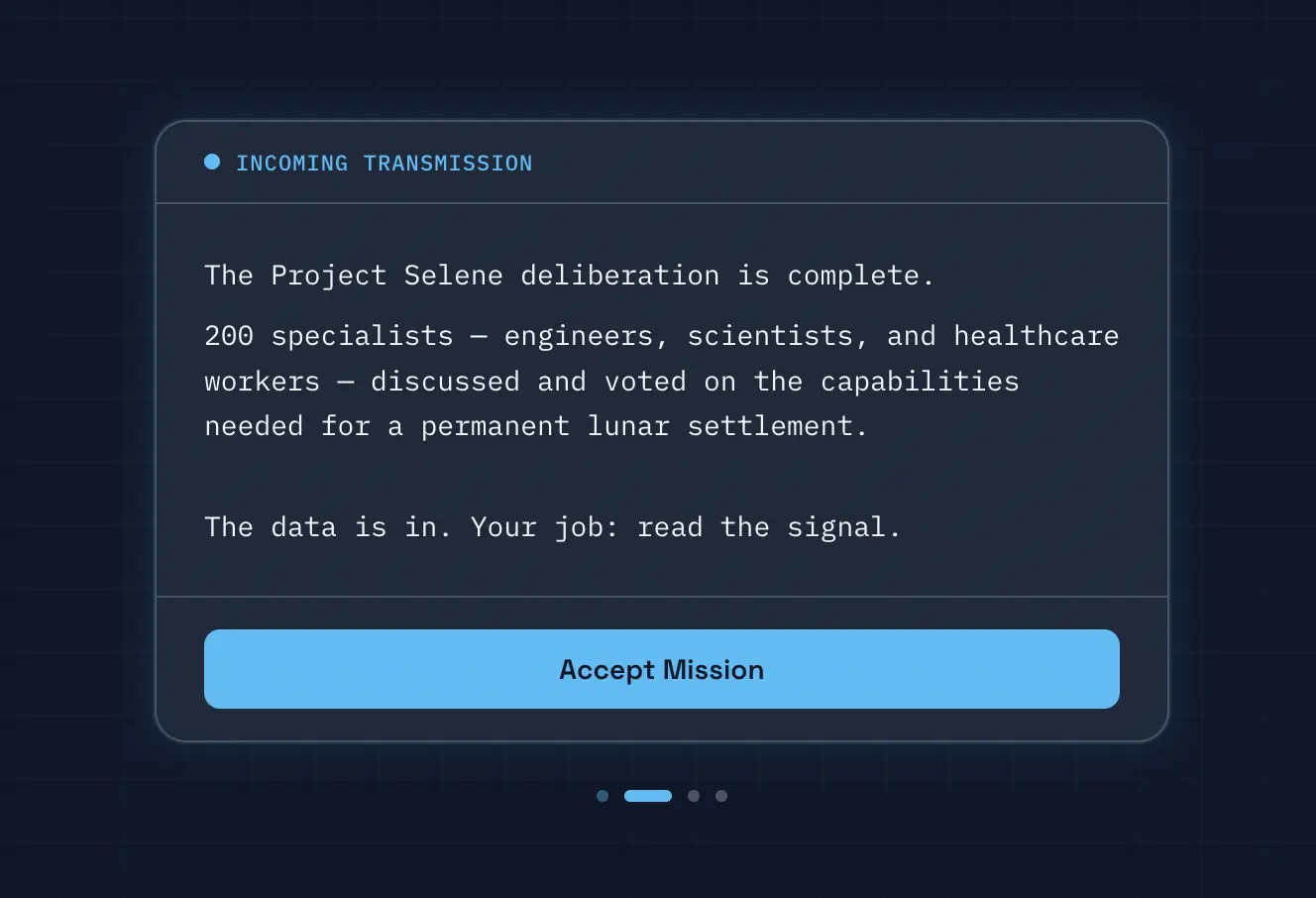
The Analysis Workstation puts you in the role of a data analyst reviewing the results of a large-scale deliberation. Two hundred specialists from around the world proposed and voted on capabilities for a permanent lunar settlement. Your job is to explore the data across seven chapters — from overview statistics and participant profiles to statistical inference, predictive models, and conversation analysis — then prove you understand what the numbers mean by passing a quiz at the end of each chapter. The game teaches you how to read and interpret PSi analytics, including ANOVA tests, effect sizes, collaborative filtering, reward models, and argument mapping.
At a Glance
Format Digital
DigitalTime30–45 minutes
Group size1 player (solo)
FacilitationLow
PriceFree
Learning Outcomes
- Understand what summary statistics like engagement rate and polarisation actually tell you about a deliberation
- Get comfortable navigating dashboards with multiple tabs, filters, and chart types
- Know the difference between describing data, testing a hypothesis, and making a prediction
- Read statistical results — p-values, confidence intervals, effect sizes — without needing a stats degree
- See how machine learning models can predict voting patterns and estimate idea quality from text alone
- Follow how arguments for and against ideas are extracted and organised from conversation transcripts
- Spot where automated tools like sentiment analysis get things right — and where they fall short
- 1You're briefed on a fictional scenario: 200 specialists have just finished a structured deliberation about building a lunar settlement.
- 2You explore the results chapter by chapter — starting with the big picture and going deeper into who voted, what they voted for, and why.
- 3Each chapter opens with a short narration explaining what you're looking at and what to pay attention to.
- 4You then get hands-on time with the interactive charts, maps, and tables — explore at your own pace.
- 5At the end of each chapter, you answer three questions to check you've understood the data. You can always go back and look at the charts again.
- 6Finish all seven chapters and see how you scored overall.
Explore data chapter by chapter.
Coming Soon
Questions? Contact us